

FAQ pages have long been a point of debate in the SEO community. Some marketing professionals see them as meaningful drivers of traffic and authority, while others write them off as thin, low-value content that adds bulk to a site without moving the needle. That skepticism isn’t unfounded—done poorly, FAQ content can be exactly that.
But this criticism often relies on the wrong metric. As zero-click search has grown—through AI Overviews (AIOs), People Also Ask (PAA) boxes, and featured results that surface answers directly on the SERP—traditional traffic tells an incomplete story. A brand whose FAQ content is cited in an AIO or populates a PAA box earns visibility, association, and authority whether or not a user clicks through. The customer saw the brand. The AI system sourced it. Over time, that presence builds familiarity and trust long before someone is ready to convert. Below, we’ll break down how to approach FAQ content strategically—and examine how this approach translated into real results for one of our clients.
Why FAQ Pages Matter for Modern SEO
The importance of FAQ pages comes down to how they influence visibility, credibility, and control in today’s search landscape.
FAQs Align with How Search Results Are Structured
What makes FAQ content particularly well-suited for the current SERP environment is its direct question-and-answer structure, which mirrors how PAA boxes present information and how AI systems source and synthesize answers. FAQ schema markup reinforces that signal explicitly, telling search engines precisely how to read and surface the content. And because FAQ sections are built around question-intent queries by design—the specific queries most likely to trigger PAA boxes and inform AI Overviews—they earn that visibility more naturally than content types that answer questions incidentally rather than structurally.
Struggling with these marketing challenges?
Our team specializes in turning obstacles into growth opportunities.
Talk to an ExpertComprehensive FAQs Build Topical Authority & Trust
Beyond placement, comprehensive FAQ coverage builds topical authority. Brands that answer questions thoroughly across a subject area signal credibility to search engines and AI systems—demonstrating the kind of genuine expertise that strengthens E-E-A-T and builds trust with prospective customers. A well-structured FAQ section also supports site architecture through internal linking, connecting to service pages, location pages, and blog content in ways that distribute authority across the site.
Owning Your Answers Is a Competitive Necessity
The competitive reality is simple: every question in your industry is being answered by someone. If your brand isn’t the one answering it, a competitor is—earning the citations, visibility, and authority that come with being the trusted source. But there’s another dimension beyond competition: when your brand doesn’t provide its own answers, AI systems fill the gap with whatever information they can find—which may not reflect your messaging, accuracy, or positioning. A deliberate FAQ strategy helps ensure your brand is represented in AI-generated results on your own terms.
Tips for Developing an Effective FAQ Strategy
Before building out FAQ pages, audit what already exists. Identify thin or duplicate FAQ content, pages that may be cannibalizing each other, and any pages already earning impressions that could be optimized rather than replaced. This creates a clean foundation for your strategy—and often surfaces quick wins before a single new page is written. Here are some more suggestions for developing a strong FAQ strategy.
Gather Insight on Customer Language
FAQ pages are not only structured for search engines—they also reflect how real people ask questions. Customer call data, support tickets, live chat transcripts, and third-party review language are all sources of this signal. The value isn’t just in finding common questions—it’s in finding how customers actually phrase them. The language a real customer uses when they’re hesitating before a purchase is often more specific, more conversational, and closer to an actual search query than anything a keyword tool surfaces. The objections and hesitations that come up right before a conversion decision are also the highest-intent FAQ opportunities.
Conduct a Competitive Gap Analysis
A competitive gap analysis helps identify topics and questions competitors are covering that your brand is missing, allowing you to expand your FAQ footprint more strategically. The goal is to identify two types of gaps: topical gaps, where competitors have entire subject areas covered that you don’t, and query gaps, where you cover a topic but are missing specific question variants within it. Both matter. AI-assisted research accelerates this by generating the full universe of questions a customer might ask about a topic—surfacing non-obvious variants that keyword tools miss because they rely on existing search volume rather than anticipating emerging queries.
Map Intent & Cluster Questions
Scalable content strategies require both search intent mapping and strategic keyword clustering in order to be effective. Intent mapping is the process of identifying the underlying user goal behind various search queries to determine where intents overlap or diverge. This analysis dictates what warrants a standalone URL vs. what should be folded into existing pages. For example, questions with distinct informational intent and high search volume should have dedicated pages, while simple clarifications belong within broader content.
Keyword clustering works alongside intent mapping by grouping related questions and terms into topic clusters before anything is written. That structure reinforces topical authority across the cluster and informs internal linking so no individual page is left to stand alone. Proper clustering and intent mapping also serve as the first line of defense against keyword cannibalization—ensuring FAQ pages are built with clearly differentiated focus from the start rather than competing against each other after they’re already indexed.
Utilize Fan-Out Query Mapping
Fan-out query mapping takes a seed question and systematically maps every related question branching from it—first-level variants of the original question, and second-level questions that arise from answering those. A single question about pricing, for example, naturally fans out into dozens of related queries across features, comparisons, and requirements.
Mapping both levels is what connects FAQ content to topical authority—search engines and AI systems evaluate comprehensive topic coverage, not just individual page rankings. Every unmapped branch is a gap a competitor can fill.
Be Strategic with Content Format & Internal Linking
FAQ page formatting and internal linking should be intentional from the start, not treated as an afterthought. The foundation is simplicity—users and AI systems come for quick, direct answers, so content should be clear, scannable, and immediately useful. Once the basics are solid, enhancing the experience with embedded video content or supporting imagery can further improve engagement and expand how content surfaces in search.
Internal linking also plays a critical role: connecting to related FAQ pages and relevant site content (like guides or service pages) reinforces topical authority and creates natural pathways for deeper exploration. Equally important is how users reach these pages—linking to FAQs from blogs and hub content helps surface high-intent questions at the exact moment users are evaluating their options.
Build FAQ Pages That Support the Sales Funnel
FAQ pages should be built with the sales funnel in mind—answering the question is step one, but guiding the user to a logical next action is what drives value. Clear, contextually relevant calls-to-action help move users from information to consideration without disrupting the experience. When approached this way, FAQ pages function as both high-performing SEO assets and effective conversion touchpoints.
How Strategic FAQs Can Lead to Measurable Results
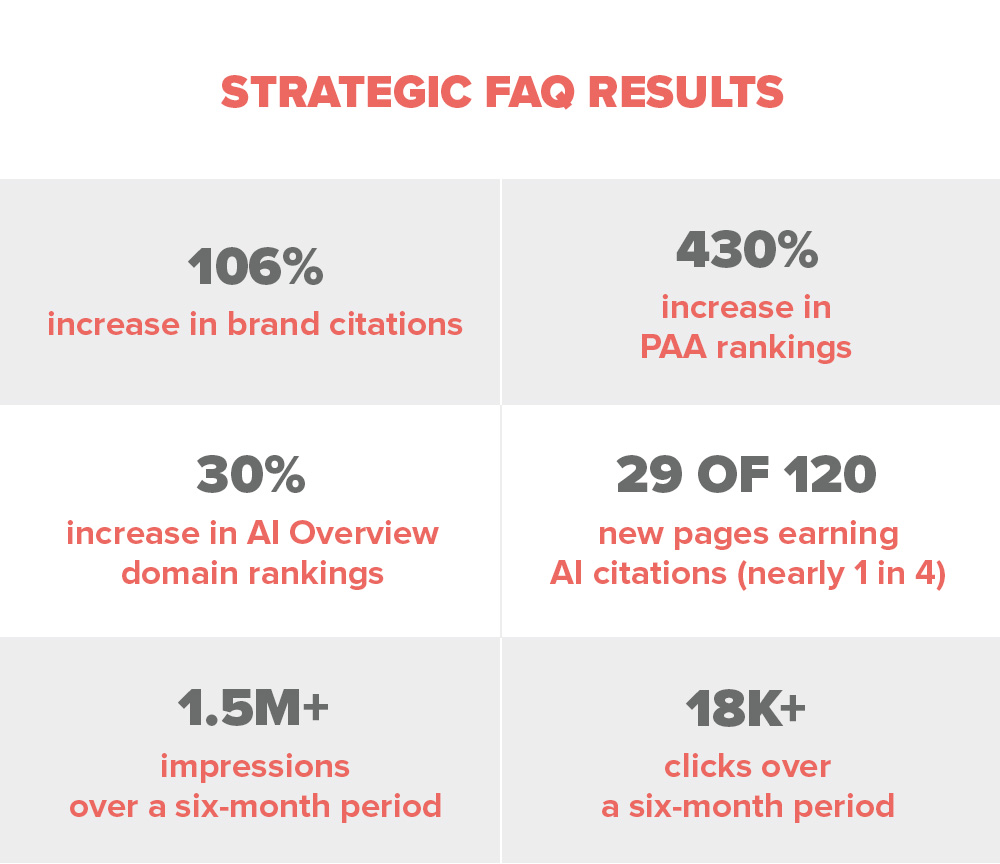
The goal of a comprehensive FAQ expansion strategy isn’t just increased traffic—it’s expanded presence across the full search landscape. Using this approach, our client’s FAQ section grew by 162%, with over 100 new pages published across a six-month period. Baseline metrics were captured before the first page went live, with final data pulled roughly one month after the last page was published—giving the newest content time to index before measuring results. What that data showed:
- 106% increase in brand citations
- 430% increase in PAA rankings
- 30% increase in AI Overview domain rankings
- 29 of 120 new pages earning AI citations (nearly 1 in 4)
- 1.5M+ impressions over a six-month period
- 18K+ clicks over a six-month period
Notably, 40% of all brand citations came from the newly created FAQ content. The takeaway is not just increased traffic, but expanded presence. For this client, strategic FAQ investment meant showing up at the exact moments users were seeking answers across an entire topic area.
Long-Term Benefits of FAQ Pages for SEO
FAQ content doesn’t peak at launch—it accumulates. Pages that earn citations and PAA appearances early create authority signals that make subsequent pages easier to place. Coverage compounds into topical authority, and topical authority compounds into the kind of brand presence that influences both search algorithms and purchase decisions. The brands investing in this infrastructure now are building something that takes time to replicate. FAQ pages serve as a powerful brand marketing tool by establishing authority and trust through expert answers to real customer questions and concerns.
Need help developing effective FAQ pages across your website? Hurrdat provides expert marketing services like SEO , AI SEO, and content marketing to build and optimize FAQ pages that drive real results. Get started today!